
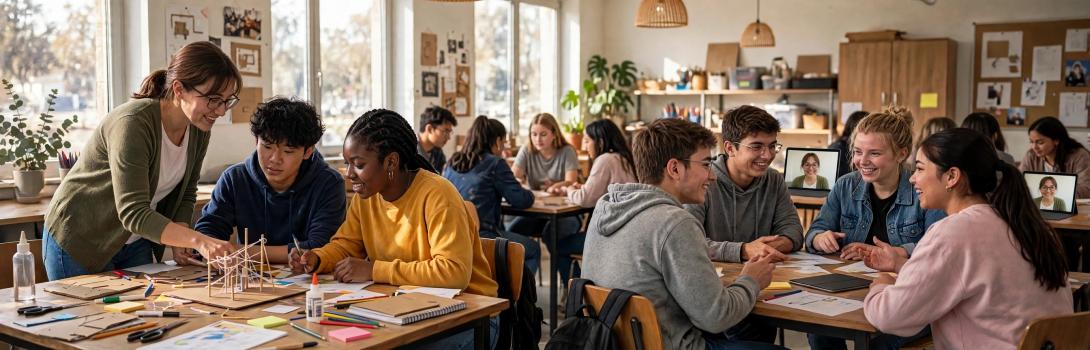
I was invited to give a keynote in Bridgeport, CT for Bridgeport Youth Lacrosse — a serious speech about education and technology, for a summit on sports and education. But the keynote was only the beginning of the day. I spent the rest of it in breakout sessions with over a hundred students, listening to them and learning about their needs. And the conversations we had taught me a lot about what is happening in school, at home, and in students' lives — more, I suspect, than my speech taught them.
The question I kept coming back to was a simple one. Anybody can use AI to get an A now. The essay writes itself, the homework completes itself, the grade arrives on schedule. And everybody getting an A doesn't stop you from getting one — there's no quota. But the question underneath is: do you learn? Do you come away with the knowledge to succeed in life — the skills, the creative skills, the problem-solving skills? What struck me, sitting with those students, is that they weren't defensive about it. They were fascinated by the other possibility: using AI to actually learn.
An A used to mean something because you couldn't get one without learning. The grade was a certificate, and the learning was what it certified. AI has quietly separated the two. The certificate is now available on its own — collectible, submittable, and empty. Nobody is harmed by anyone else's empty A; grades aren't rationed. But a generation of students collecting certificates without the capability underneath them is a real risk, and it isn't the students' fault. Given a machine whose only job is to hand over answers, using it exactly as designed is the most natural thing in the world.
Because there are two kinds of AI entering education, and they are not the same. One is an answer machine: ask, receive, submit, forget. The other is a teacher: it makes the learner do the work, checks the work, and doesn't move on until the work holds. The technology underneath is the same family. What differs is the design — and the design decides which future we get.
Teaching design is not mysterious; good teachers have always done it. At Knowledge Avatars we formalized it as FEED. Every concept is taught through Feedback on the learner's own attempt, Examples that show the idea at work, Experiences the learner takes part in, and Definitions that name what was just learned. The learner is working at every step — there is no answer to copy, because the answer is the last thing the process produces, not the first. A Knowledge Matrix underneath holds the order of concepts, so a learner cannot skip ahead to the answer without the steps that make the answer mean something. And the teaching comes from a real expert's knowledge, so what is learned can be trusted. That is the difference between an AI that creates dependence and one that creates capability.
And teachers have the same problem from the other side. They have no time — no time even to think about AI, let alone to choose carefully among its designs. So the answer machine arrives in their classrooms by default, not by decision. If we want a different outcome, teachers need tools designed to teach, and room to think about the difference before the default decides for them.
So the question is not whether students should use AI. That question has already been answered by the students themselves, and the answer is yes. The question is which kind we are giving them. Do you want to learn, or do you want an A? One of those builds the skills, the creative skills, the problem-solving skills that a life runs on. The other is paper. Our job — teachers, schools, and those of us building these tools — is to make sure the first one is the one in their hands.