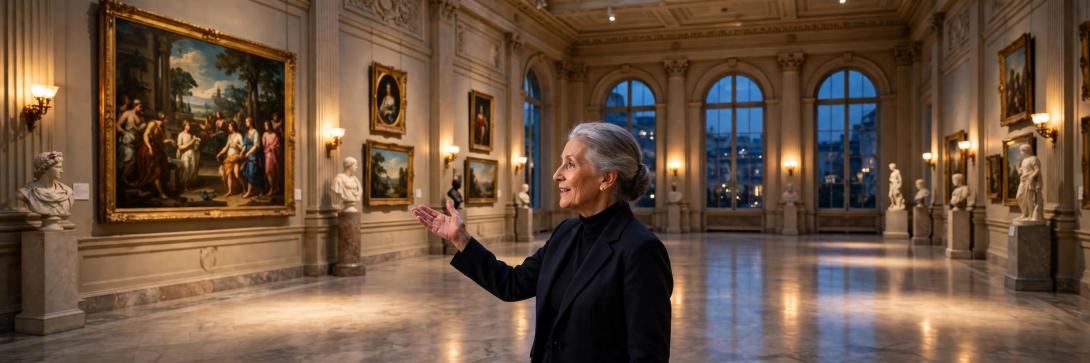
Every museum has her. She has volunteered for thirty years, she gives the Thursday tour, and she knows things no label copy will ever tell you — which portrait makes schoolchildren go quiet, what the founder's letters actually say, the one question visitors ask that takes ten minutes to answer properly. She is the interpretive heart of the museum. She is also there four hours a week, and one day she will retire, and most of what she knows will go home with her.
That is not a criticism of docents. It is the arithmetic of the model. Docent corps are volunteers, trained over months at real cost to the museum, and available only in limited hours. But visitors do not arrive only in those hours. A school group comes at 8 a.m. A family has twenty minutes and still wants the good story. A researcher across the world is on the museum's website at midnight. A first-time visitor who speaks little English stands in front of the museum's most important object, wanting exactly what that Thursday docent would have given her — and the gallery is silent.
A Knowledge Avatar docent closes that gap, and it starts from the same place a human docent does: the museum's own knowledge. An Avatar is trained concept by concept on the institution's scholarship — its curatorial research, its tour scripts, its archives — structured so the connections between ideas are explicit and every answer traces back to a trusted source. It teaches the way the best docents teach: with Feedback, Examples, Experiences, and Definitions, the FEED framework behind every Knowledge Avatar. It stands in the gallery on a kiosk or through a QR code beside the object, and on the museum's website after hours, in more than one language, answering the questions visitors actually ask. It never calls in sick, never retires, and never forgets.
None of this replaces the human docent. It preserves her. Her tours, her training materials, her stories become the Avatar's curriculum — which means her knowledge stays in the building permanently, teaching on the days she cannot be there. And through our exclusive partnership with Royalty Now Studios, a museum can go one step further: the historical figures themselves, in historically researched, photorealistic likeness. George Washington can greet visitors at his own library. King Tut can speak for his own exhibition. The docent corps gains members it could never recruit.
Which is why this season matters. The end of the year is when a museum's friends and benefactors decide what their generosity will build. A sponsored docent Avatar is a different kind of gift: named, permanent, and at work every day the museum is open — and every night on its website. A donor is not funding a gala or a plaque. They are underwriting a teacher who will still be answering questions a generation from now. Museums that confirm a pilot docent through our Founding Museum Partner program by December 31, 2026 keep founding terms — and give their donors something lasting to point to in the year-end appeal.
If you lead a museum, the question is not whether visitors will ask questions at midnight. They already do. The question is whether anyone is there to answer. And if you love a museum, ask them what a docent who never sleeps would be worth — then consider being the person who gives her to them.