When Harvard's researchers reported their striking result last year — students learning more than twice as much with an AI tutor as in an active-learning classroom, in less time — most coverage treated it as a story about artificial intelligence. Read the study closely and it is a story about a teacher. Greg Kestin and his colleagues did not point a generic chatbot at a physics course and hope for the best. Instructors designed the tutor: they wrote the prompts around their own problems, structured the guidance their students would receive, and decided what the tutor should never simply hand over. The technology delivered the lesson. The teaching was theirs.
That distinction is now the central question in AI and education. A generic model knows a great deal about the internet and nothing about your classroom. It does not know what you taught last Tuesday, which misconception your students bring to this topic every year, or why you sequence the material the way you do. It answers fluently, confidently, and without accountability to any curriculum — or to any student. Put that in front of a class and you have not amplified a teacher. You have bypassed one.
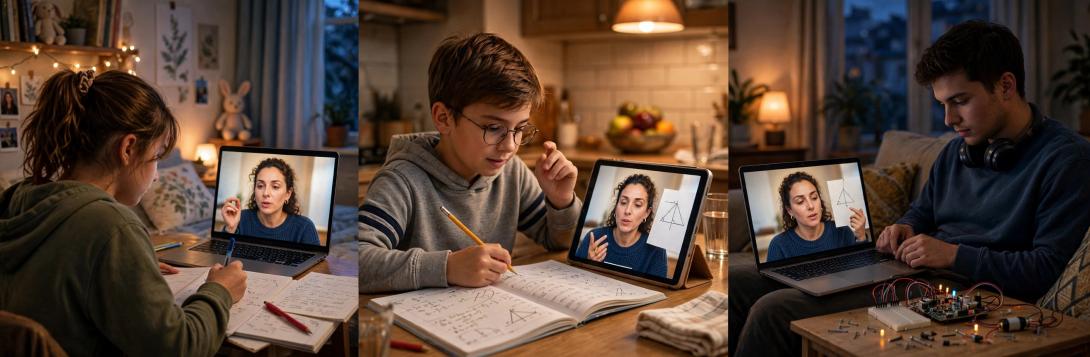
A Knowledge Avatar starts from the opposite end. The teacher builds it, concept by concept, from her own material, in her own likeness and voice. She decides what a concept is, how it connects to the concepts around it — the map we call the Knowledge Matrix — and how each student will be worked through it: Feedback that shows learners where they stand, Examples that teach them to generalize, Experiences that let them learn by doing, and Definitions precise enough to build on. That is the FEED framework, and it is not a feature added to a chatbot. It is the teacher's own pedagogy, made durable. When a student asks a question at midnight, the voice that answers is not a model's best guess at teaching. It is their teacher, teaching the way she teaches, from a source the school chose and can trust.
There is another answer taking shape, and it is worth contrasting honestly. Some ventures are building entirely new, expensive AI schools from scratch — new buildings, new brands, tuition to match — on the premise that education must be replaced to be improved. We believe the better bet is the schools already here. Forward-leaning, progressive schools do not need to be displaced by a technology company; they need their own teachers scaled. A Knowledge Avatar lets an existing school keep its faculty, its philosophy, and its community, and give every one of its students the one thing research has always said works best and budgets have always denied: one-on-one tutoring, at each student's own pace, around the clock.
That is why we say the teacher is the technology. Not because software can replace the judgment, warmth, and responsibility of a human educator — it cannot, and a tool that promises to should be distrusted. It is because, for the first time, a teacher's expertise does not have to end at the classroom door or the school day. It can be present for the homework question, the missed week, the student who needs the explanation a fourth time without embarrassment. Harvard showed what a teacher-built tutor can do for one course, built by hand. Knowledge Avatars puts that same building in every teacher's hands. The future of AI in education will not be decided by which model is smartest. It will be decided by whose teaching the model is delivering — and our answer is: the teacher's.